
We have all witnessed the standard corporate playbook. An organisation spends months procuring a shiny wellbeing platform or rolls out subsidised lunchtime yoga, only for engagement to hover stubbornly in single digits. Meanwhile, stress quietly builds in the background.
Data reveals why these superficial (albeit nice) perks fail to shift the dial.
In the UK alone, poor mental health costs our economy up to £99 billion every year, while around 8.5 million colleagues report that their work actively harms their health. Even more alarming, 34% of UK employees feel regularly lonely at work.
You cannot downward dog your way out of excessive workloads, nor can a meditation app compensate for an emotionally depleted team environment.
People rarely leave organisations because of a missing perk. They leave managers, or more accurately, they leave poor relationships.
Decades of research, including the landmark Harvard Study of Adult Development, confirm an enduring truth. High-quality human relationships represent the single greatest predictor of lifelong health, happiness, and life satisfaction. When trust exists, people flourish. When trust is absent, individuals retreat into self-protection, cognitive fatigue, and quiet resignation.
I want better for you and your organisation.
If we are to build workplaces that replenish energy rather than drain it, we need to focus on the true currency of human fulfilment. That journey begins with building trust in teams through meaningful wellbeing conversations.
At Joy Junction, we reject the notion that solving workplace wellbeing requires an ever-expanding budget. It demands a joined-up system.
Lived workplace culture operates across three interconnected levels, encompassing individual agency, team relationships, and organisational design. When these three tiers work in harmony, they create a virtuous cycle that turns wellbeing into a genuine competitive advantage.
Wellbeing is never something an employer can do to people from the top down. It must be co-created with them.
Trust grants employees the psychological permission to manage their own energy budgets, set healthy boundaries, and take meaningful micro-breaks, without feeling guilty about it.
When colleagues feel trusted, they stop behaving like passive recipients and instead embrace frameworks like the Five Ways to Wellbeing (Connect, Be Active, Take Notice, Keep Learning, and Give), finding practical ways to nurture their own mental and physical health.
However, personal resilience can only stretch so far. An individual cannot flourish if their daily working environment is suffocating them.
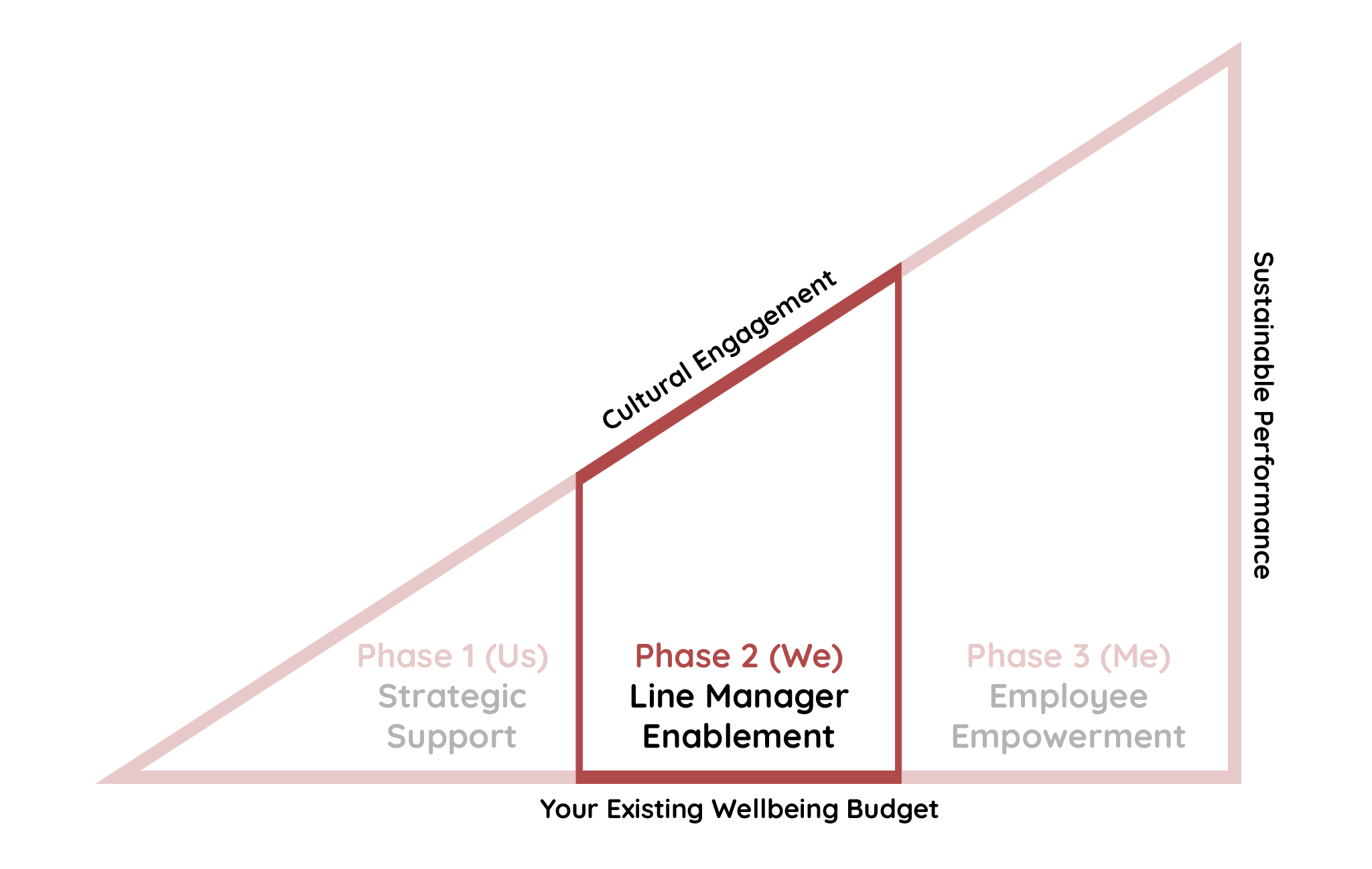
This brings us directly to Phase Two of the Joy Junction Method, where team dynamics and line manager capability make or break the employee experience.
Research from the Workforce Institute reveals that a line manager influences an employee's mental health more than their doctor or therapist, matching the impact of a partner or spouse.
Despite this responsibility, most team leaders are accidental managers. They were promoted because of technical expertise, not people skills, and left stranded without the human tools to lead. Consequently, they dread sensitive conversations, terrified of saying the wrong thing or overstepping perceived boundaries.
This isn’t their fault, it’s ours as People Professionals, and this is where the Conversation Canvas changes everything.
The Conversation Canvas is a free, simple, semi-structured tool, designed to dismantle awkwardness. Built upon the “Five Ways to Wellbeing” and “Me, We, and Us”, it gives managers the confidence to lead empathetic, two-way conversations.
Rather than conducting a cold interrogation about targets, managers learn to ask open questions about connection, support, and workload.
Crucially, the Canvas doesn’t ask managers to play clinical therapists. It empowers them to become professional signposters.
When managers listen with genuine curiosity and empathy, psychological safety takes root. Team members feel seen, heard, and valued. That security directly reduces turnover, which Gallup estimates costs between 50% and 200% of an employee's annual salary to replace.
Senior leadership needs to provide the structural scaffolding that makes trust possible.
Most companies already sit on an untapped goldmine of support, but because these services are scattered across convoluted intranet pages and apps, colleagues simply don’t know they exist.
Phase One of our Method focuses on auditing and centralising these primary and secondary services onto a clean, accessible map.
When leaders remove friction to the user journey, communicate with transparency, and visibly role-model healthy working boundaries, they prove that care is an operational value, not empty rhetoric. Trust cascades from the boardroom straight to the front line.
The trust advantage is neither an abstract philosophy nor a soft corporate sentiment. It’s a proven operational driver.
When organisations focus on building trust in teams through wellbeing conversations, they unlock the exact conditions where human capability expands. Employees experience greater happiness, teams collaborate with psychological safety, and the business reaps the rewards of loyalty, creativity, and sustainable productivity.
Who doesn’t want that?!
You don’t need to hunt for extra budget or procure another digital gadget to achieve this. You need to unlock the immense value already present within your teams.
Are you ready to stop paying for wellbeing programmes that your colleagues ignore?
Joy Junction partners directly with senior leaders, HR directors, and executive boards to build joyful, high-performing workplace cultures. Through our bespoke senior leadership consultancy, we help you audit your existing provision, embed the Joy Junction Method, and equip your line managers with the Conversation Canvas to deliver measurable commercial and human returns.
Let us transform your employee wellbeing investment into a lasting strategic advantage. Reach out today.