
Have you ever felt that sinking feeling when you look at your engagement data for a high-spend wellbeing platform? I know I have.
You’ve invested months negotiating the contract, you’ve launched it across the organisation with a flourish, and six months later, the only people using it are the HR team and that one person who loves a step challenge.
The immediate impulse for many leaders (and I used to be one of them) is to think the "product" is the problem. We assume our people want something shinier, faster, or more "AI-driven”. So, we go back to the drawing board and ask leadership for more budget.
We keep adding more layers to an already cluttered ecosystem, hoping that the next thing will finally be the silver bullet.
I’m here to tell you that you don’t need a bigger budget. You need a better map.
The "Wellbeing Void" isn’t caused by a lack of investment. It’s caused by a lack of connection.
Most large organisations are sitting on a goldmine of support that their colleagues simply don’t know exists. If you want to know how to increase engagement in employee wellbeing without increasing budgets, you have to stop looking for the next big campaign and start making sense of what you already have.
When I consulted at The University of Sheffield, we faced this exact challenge.
It was a massive, complex organisation with incredible resources. They weren't short on provision. In fact, once we investigated what was there, we realised that they had an abundance of it. But the "user journey" was a nightmare.
Colleagues were stressed and overwhelmed during a time of sector-wide uncertainty. If they needed help, they didn't know where to turn. We realised that our biggest job wasn't to buy more stuff, it was to consolidate. We brought everything together into one place. We looked at the journey from the perspective of an employee and stripped away the friction.
By making the existing support easy to find and understand, engagement didn’t just improve, it transformed.
I’ve supported numerous organisations to do this since then and the secret isn't in the spending; it's in the simplicity.
To help you replicate this success, I use a specific three-phase model. This is the "Joy Junction" way to unlock your existing potential.
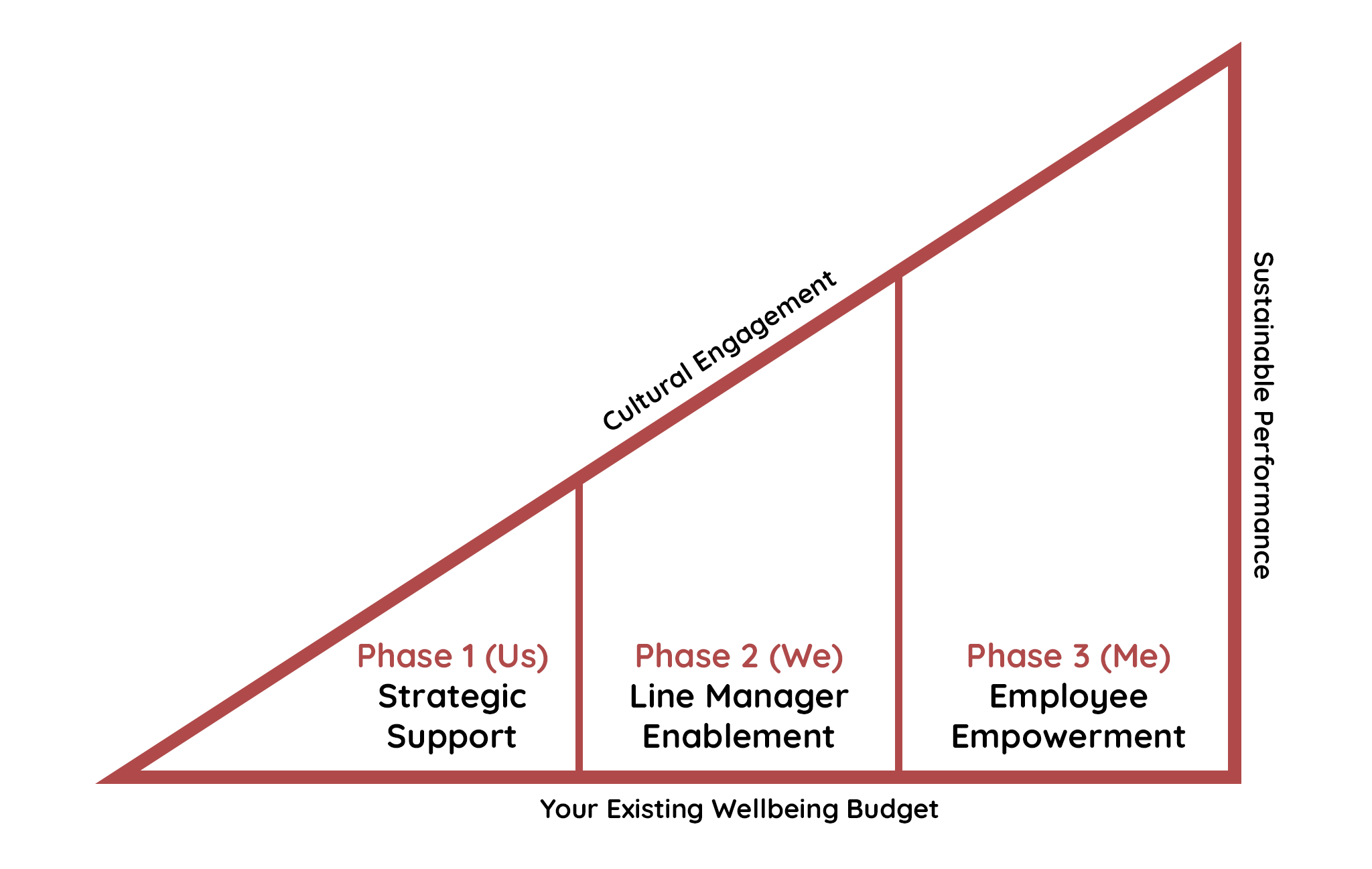
First, we have to get honest about what is actually in the cupboard. Split your provision into two categories.
“Primary” services are the ones that you know about, like your occupational health unit, employee assistance programme, or cycle to work scheme. You may have been involved in procuring them yourself. “Secondary” services are the unknown gems. These are often buried in the small print of contracts or bolt-ons to your Primary services; things like free financial coaching, ergonomic assessments, or bereavement support.
While it might seem over-simplified and not particularly "fancy", we plot every single one of these services onto a shareable spreadsheet (we like Google Sheets). When this is hosted on the cloud, it becomes a living, breathing document that is easily shareable and understandable.
Positioning your provision this way removes the mystery and makes it incredibly easy to access. This simple act of visibility is the foundation of how to increase engagement in employee wellbeing without increasing budgets.
Once you have your cloud-based map, you need to put it into the hands of the people who matter most… your line managers.
Managers are often the first to see when a colleague is struggling, but they are terrified of saying the wrong thing. They don't need to be therapists, they need to be professional sign-posters. When your managers have all the information they need at their fingertips via your Phase 1 spreadsheet, they can do a lot of the heavy lifting for you.
We use our "Conversation Canvas" to teach managers how to hold meaningful wellbeing conversations. The Canvas gives managers the structure and the confidence to talk to colleagues about their wellbeing, and to point people in the right direction to the right proactive and/or reactive support, at the right time.
This shifts the burden from HR and places the solution right where the work happens.
The final phase is about the individual. We cannot do wellbeing to people. They have to want to engage with it.
To make this happen, we have to give employees the models they need to take personal responsibility for their own health and happiness.
We use research-based, incredibly scalable models like the "Five Ways to Wellbeing". We also use our core "Me, We, and Us" framework to help colleagues understand where their influence lies.
When people have a clear framework to filter their choices through, they stop feeling like passive recipients of a corporate benefit and start feeling like active participants in their own lives.

We are living in an era of "wellbeing clutter". People are tired, and they are being shouted at by a dozen different apps and initiatives.
Adding more noise to the room isn’t the answer. The most bold and effective thing you can do right now is to stop searching for new things and start looking at your Primary and Secondary services.
Get them on a spreadsheet. Empower your managers with the Conversation Canvas. Give your people the "Me, We, and Us" model to navigate their own path.
This is how you build a culture of joy. It’s not about the size of your wallet, it’s about the clarity of your vision and the ease of your journey. When you fix the connection, the engagement will follow.
That is how to increase engagement in employee wellbeing without increasing budgets for the long term.
If you are ready to stop the cycle of endless spending and start seeing real engagement from your existing resources, I can help. Let’s work together to audit your services, empower your managers, and implement the Joy Junction models that actually work.
.webp)

.avif)
