What Andy Burnham as Prime Minister could mean for employee wellbeing

A photo of the Downing Street street sign.

Key Takeaways

  • A vision of renewal: Andy Burnham’s arrival as UK Prime Minister brings his track record as Mayor of Greater Manchester, from the Good Employment Charter to his philosophy of a “preventative state”. Into national focus, offering a fresh, human-outlook for public sector workforce wellbeing.
  • The high cost of audit culture: Public sector workplaces are suffering under rigid metrics, high burnout (4.98/10), and wellbeing clutter, where less than a third of employees leave reviews feeling valued.
  • The Joy Junction Method: By applying our Method across your organisation, managers, and individuals, leaders can turn Andy Burnham’s preventative philosophy into daily reality using existing budgets.

Before we get into this long read, I want to get a few things out of the way.

  • First, you should know that I’m a life-long Labour supporter, so there will obviously be an element of bias in the way that I view things.
  • Second, Whilst Sir Keir Starmer’s ideology more closely matches mine, I would’ve voted for Andy Burnham in the by-election (but I’m blessed to be from Leeds).
  • Finally, and perhaps most importantly, this article is speculative. The Prime Minister hasn’t yet outlined his priorities outside the current Labour manifesto, so I’m going from his first speech at 10 Downing Street and his previous work as Mayor of Greater Manchester.

Now that’s done and dusted, let’s crack on.

Whilst I’m writing this blog through a public sector lens, I think there’s opportunity in all other sectors here before it becomes Government policy. 

What Andy Burnham as Prime Minister could mean for employee wellbeing

Whilst I think the treatment of Sir Keir Starmer was shambolic, I do feel a sense of renewal in the air. Anyone who follows me on social media for five minutes will know which way I lean politically, and I think this has been a good move for the Labour Party, even if I don’t agree with the method. 

Stepping onto Downing Street yesterday as the UK’s new Prime Minister with an unscripted, no-notes opening address, Andy Burnham signaled a clear shift in tone. Promising a “circuit breaker for Britain”, he spoke passionately about moving toward a “preventative state”, one that invests in people’s success rather than “paying for failure”, puts care at the heart of public service, and tackles issues from the ground up rather than the top down.

While specific national policy details will emerge in the coming weeks and months, we don’t need to guess where his heart lies. Andy Burnham’s track record as Mayor of Greater Manchester, most notably his pioneering Good Employment Charter, his push for whole person care, and his focus on local, health-led community support, gives us a clear yardstick for what his leadership could mean for the world of work.

For those of us leading HR, Organisational Development (OD), and employee health across the NHS and wider public sector, this moment comes, to me at least, like a breath of fresh air. It is an invitation to move away from rigid, anxiety-inducing audit cultures and start designing work that acts as an energy-giver, not an energy-drainer.

Running on empty in an audit culture

If we look at the reality on the ground across our public services, traditional approaches to employee health are buckling under pressure. We’ve spent years layering initiative upon initiative, yet the metrics tell a sobering story:

  • Critical burnout levels: The national NHS burnout sub-score sits at a critical 4.98 out of 10, with 43.03% of employees feeling worn out at the end of every shift.
  • Prevalent presenteeism: A staggering 56.01% of healthcare workers admit to attending work despite not feeling well enough to perform their duties.
  • The "value" deficit: Only 42.95% of employees feel satisfied with the extent to which their organisation values their work.
  • Transactional reviews: While appraisal coverage reaches 86.42%, a paltry 26.01% say it actually helps them do their job better, and only 32.86% leave the room feeling valued.

To make matters worse, most organisations are sitting on a mountain of wellbeing clutter; a disjointed mix of apps, platforms, and secondary benefits hidden away in buried intranet PDFs that employees simply don't know exist. 

We pay for support, but because the user journey is convoluted, engagement sits in single digits. 

The high cost of "paying for failure"

Andy Burnham’s critique of systems that "pay for failure" is bang on the money. 

When organisations handle wellbeing reactively (waiting for employees to reach a breaking point before offering support) the financial and human costs are staggering.

Under the July 2026 NHS employee Standards and the Workplace Health Intelligence Unit (WHIU) mandates, Trusts face public performance exposure and direct regulatory consequences if workforce health and return-to-work metrics lag.

Losing experienced employees doesn't just damage morale; replacing a single departing colleague costs between 50% and 200% of their annual salary in recruitment and agency coverage. Further, with workplace relationships under strain (only 46.73% of employees report that work relationships are rarely or never strained), we cannot afford to treat people like cogs in a machine or rows on a spreadsheet.

A yoga class or a fruit bowl won't fix a systemic cultural issue. We need a joined-up strategy.
Bringing the Joy Junction Method to life

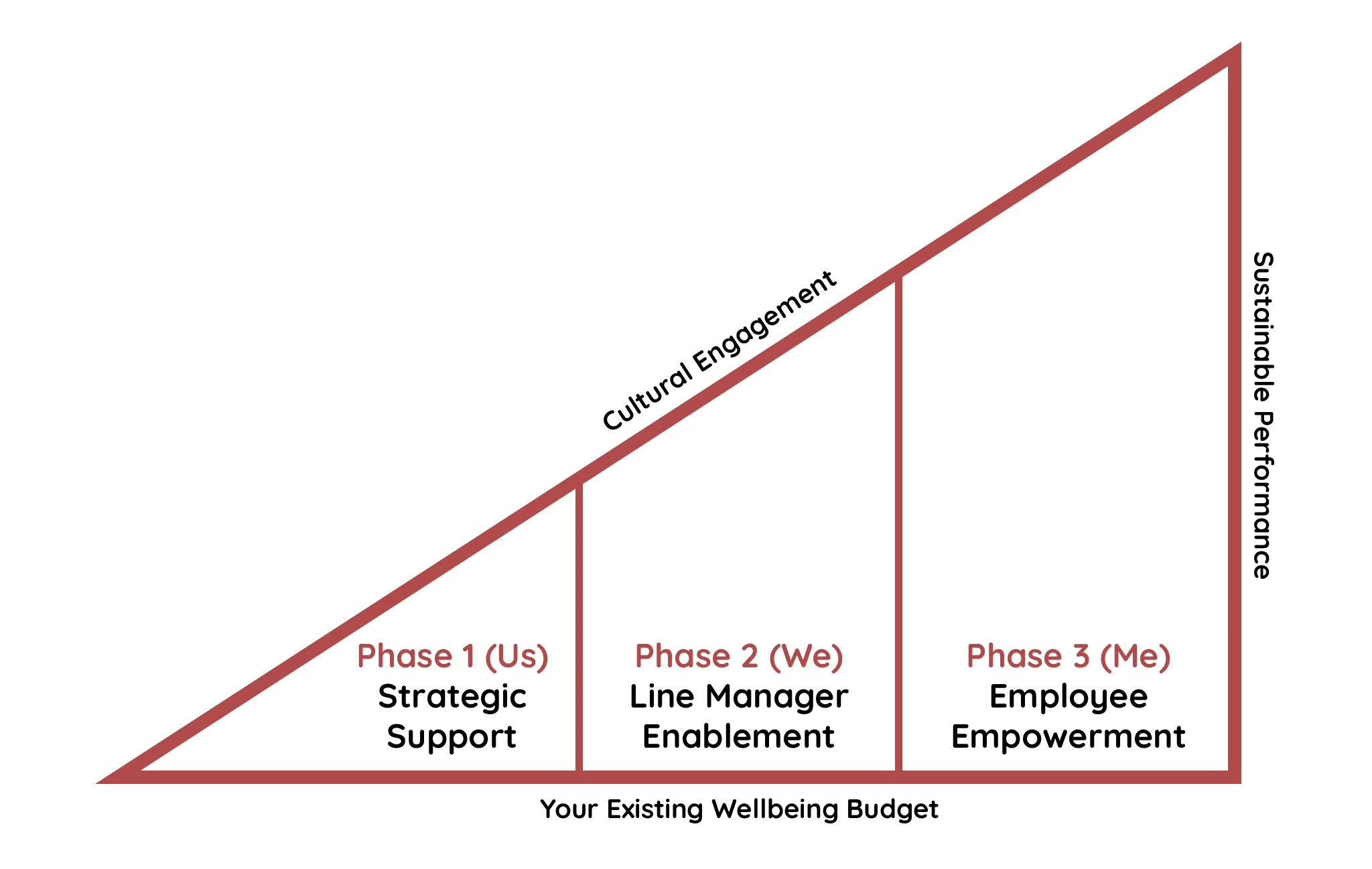
Our Joy Junction Method. Phase 1 (Strategic Support), Phase 2 (Line Managers Enablement), and Phase 3 (Employee Empowerment), all driving cultural engagement and sustainable performance, without increasing budgets.

The great news is that creating a preventative, high-performing workplace culture doesn't require a bigger budget. It requires a clearer map.

In Greater Manchester, Andy Burnham championed the idea that good employment with fair pay, flexible working, voice, and healthy environments, is a driver of prosperity, not a luxury. 

The Joy Junction Method provides the practical, three-tiered framework, which you can utilise, to make that ethos work inside your own organisation.

Phase 1 (Us): Strategic support & organisational foundation

At the organisational level, we need to clear out digital clutter and build an accessible, joined-up foundation to work from.

  • Audit and centralise your offer: Stop buying new software. Map your existing primary services (Occupational Health, EAPs, Cycle to Work etc.) and secondary benefits (financial advice, career support, legal helplines, webinars etc.) onto a single, cloud-based page (a Google Sheet works brilliantly). When we consolidated our proposition at the University of Sheffield, simplifying access transformed engagement without extra spend.
  • Align with WHIU data requirements: Streamline internal HR systems to track return-to-work outcomes and early sickness indicators, giving boards the transparent metrics needed for oversight.
  • Humanise physical spaces: In line with wellbeing guidelines, update break areas with natural elements (plants, natural light). Incorporating natural elements can reduce absenteeism by 10% and boost focus and creativity by 15%.

Phase 2 (We): Line manager enablement & team dynamics

Line managers are the bridge between strategy and everyday experience. We don't need them to be clinical therapists; we need them to be confident, empathetic signposters.

  • Bolster target-only reviews for the Conversation Canvas: This tool is specifically designed to bolster the appraisal process and guides structured, two-way discussions around development, connection, and wellbeing.
  • Protect management capacity: Audit rosters alongside department heads to build dedicated, protected time for line management duties, ensuring leaders have the literal capacity to care.
  • Establish regular check-Ins: Mandate (after training) comprehensive wellbeing conversations at least once every 12 weeks, supported by light check-ins during regular one-to-ones and brief encounters.

Phase 3 (Me): Employee empowerment & individual action

Wellbeing isn't something done to people; it’s co-created with them. We need to give employees the tools and autonomy to manage their own personal wellbeing and energy budgets.

  • Adopt "natural working" & boundaries: Move away from rigid location debates toward "natural working", finding harmony between individuals, their roles, and their environment. Respect personal time with email scheduling and clear team expectations.
  • Normalise micro-recovery: Encourage 10-minute mental pauses throughout shifts. Taking micro-breaks is operationally proven to reduce shift fatigue by over a third and boost performance by 16%.
  • Use the Five Ways to Wellbeing: Run practical sessions introducing Connect, Be Active, Take Notice, Keep Learning, and Give. Pair employees up in 4-week buddy networks to build momentum and keep each other accountable.

Looking Ahead with Optimism

The political landscape through Andy Burnham is, to me, pointing firmly toward prevention, partnership, and valuing public servants. But we don't have to wait for top-down legislation to transform our working environments.

By wrapping the Joy Junction Method around your existing benefits, union relationships, and leadership frameworks, you can build a resilient, connected workplace where people feel seen, supported, and inspired to do their best work.

Let's make work a place that replenishes energy rather than drains it. Today is the day to unleash joy!
Unleash joy.
Today is the day to create a culture where people thrive and performance follows. Make employee wellbeing part of your everyday employee experience and see the different it makes.
Start Now